
Investing in Morocco with the Investment Charter: presentation and new features
Morocco's new Investment Charter has profoundly changed the country's approach to economic attractiveness.
The objective is no longer solely to offer general tax advantages.
Morocco is now seeking to attract:
- productive investments,
- job-creating projects,
- industrial and technological activities,
- export projects,
- and investments capable of developing local ecosystems.
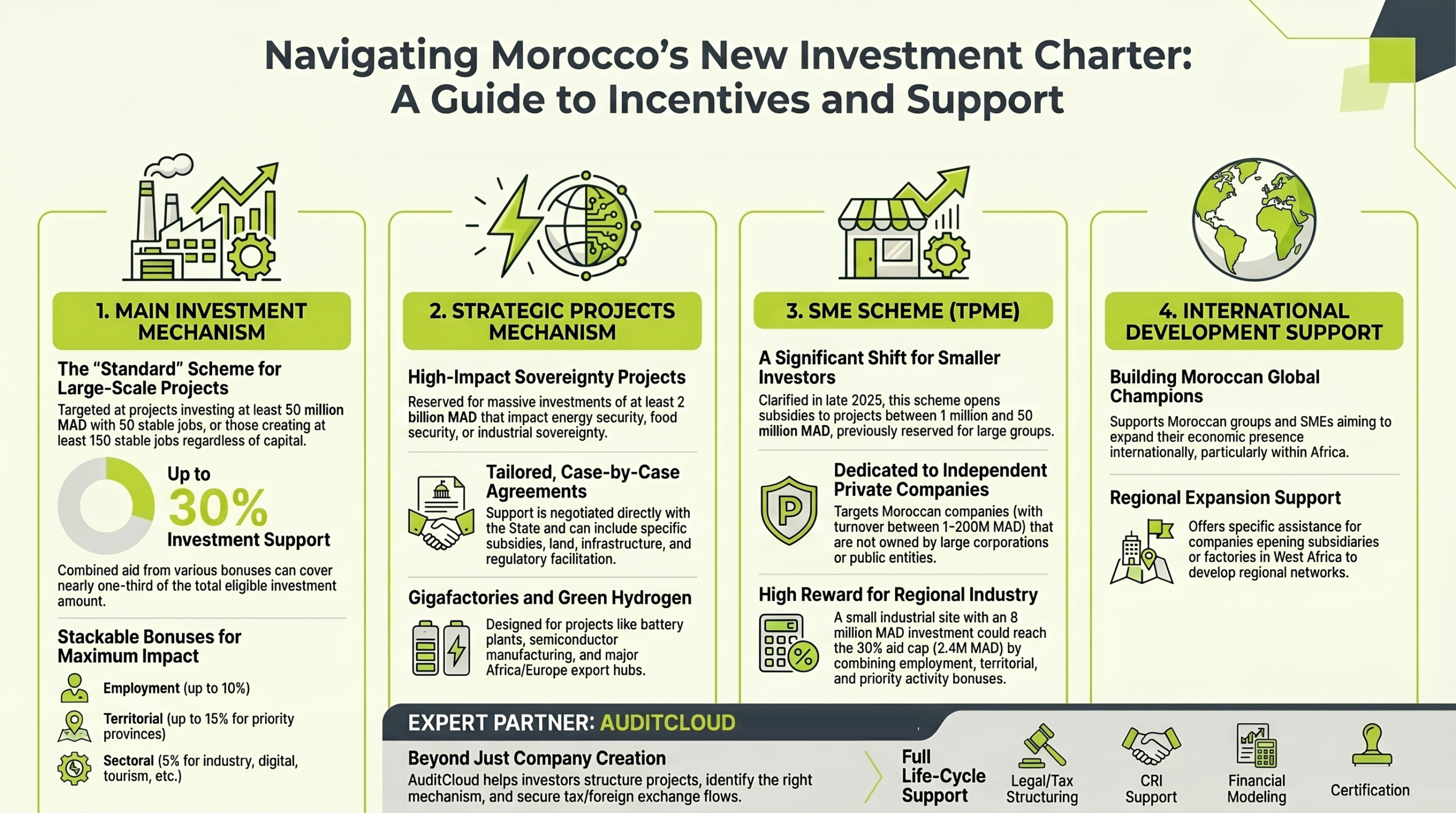
The Charter is based on 4 main support mechanisms, each targeting a different type of investor.
Main investment mechanism: intended for major investment projects.
A mechanism dedicated to strategic projects: concerns major projects having a significant impact on the economy.
SME scheme: Recently clarified by legal texts, it targets small and medium-sized enterprises.
Support mechanism for the international development of Moroccan companies: assists Moroccan companies wishing to invest and develop internationally, particularly in Africa.
1. The main investment mechanism
This is the “standard” mechanism intended for large investment projects.
What is the amount of aid available under this scheme?
The combined aid can reach up to 30 % of the amount of the eligible investment.
Which projects can benefit from this?
- representing at least 50 million MAD of investment with 50 stable jobs,
OR
- create at least 150 stable jobs.
How does the system work?
Morocco offers several bonuses that can be combined:
Employment bonus
- 5 %,
- 7 %,
- or 10 %
depending on the job intensity of the project.
Territorial bonus
10 % or 15 % if the project is located in certain priority provinces.
sectoral bonus
5 % for certain strategic sectors:
industry, digital, outsourcing, renewable energies, logistics, tourism, etc.
Other possible bonuses
- sustainable development,
- jobs of the future,
- local integration,
- female employment.
Example
A European company is opening an industrial plant with:
- 120 million MAD CAPEX investment,
- 200 stable jobs,
- establishment in a region outside Casablanca,
could potentially benefit from several tens of millions of dirhams in aid.
2. The mechanism dedicated to strategic projects
This scheme targets very large projects that have a major impact on the Moroccan economy.
Who is affected?
The projects of at least:
- 2 billion MAD,
having a significant impact on:
- employment,
- energy security,
- food security,
- industrial sovereignty,
- advanced technologies,
- or Morocco's international influence.
How does the system work?
Unlike the main scheme, here the aid is negotiated “on a case-by-case basis”.
We are moving more towards a logic of strategic agreement with the State.
This may include:
- specific subsidies,
- land,
- infrastructure,
- administrative support,
- personalized benefits,
- regulatory facilitation.
Example
For example, this mechanism could potentially apply to projects such as:
- gigafactory batteries,
- green hydrogen project,
- mega car factory,
- semiconductors,
- energy infrastructure,
- major export project Africa/Europe.
3. The SME scheme
This is probably one of the most significant changes in the new Charter, the details of which were clarified at the end of 2025. Previously, substantial aid was primarily aimed at large corporations. The SME scheme now opens access to subsidies for much smaller projects.
This device can be particularly useful for:
- foreign industrial SMEs,
- industrial startups,
- technology companies,
- small production units,
- outsourcing,
- regional subsidiaries in Africa.
Who is affected?
Private Moroccan companies created by Moroccans or foreigners.
This scheme expressly excludes companies whose shareholders include large companies or public companies:
- with a turnover between 1 and 200 million MAD,
- or new companies created less than 3 years ago.
Project conditions
The project must:
- representing an investment of between 1 and 50 million MAD,
- have at least 10 % of equity,
- create enough stable jobs,
- to be in an eligible activity and region.
Bonuses
The plan includes:
- an employment bonus:
- 5 % if the jobs/investment ratio is ≥2 and ≤5,
- 7 % if the ratio is >5 and ≤10,
- 10 % if the ratio is >10; ;
- a territorial bonus:
- 10 % for certain Category A provinces,
- 15 % for certain category B provinces; ;
- a bonus for priority activities:
- 10 % for certain targeted activities (industry, technology, outsourcing, renewable energies, etc.).
The combined aid can reach up to 30 % of the eligible amount.
Example
For example, a European SME opening:
- a small industrial site,
- a software development center,
- or an assembly unit
with :
- 8 million MAD investment,
- 20 jobs,
could potentially benefit from:
- of an employment bonus of 5 %
(jobs/investment ratio = 20 ÷ 8 = 2.5), - a territorial bonus of 10 % or 15 %
if the project is located in an eligible province, - and a priority activities bonus of 10 %
if the activity falls within the targeted sectors.
In a favorable scenario, the project could therefore obtain:
5 % + 15 % + 10 % = 30 %
That is, up to:
2.4 million MAD in potential aid
based on an investment of 8 million MAD.
4. The mechanism for the international development of Moroccan companies
This scheme aims to support Moroccan companies that invest internationally, particularly in Africa.
Who is affected?
- Moroccan groups,
- Moroccan SMEs,
- companies wishing to expand outside Morocco.
Objective
Morocco is seeking to:
- encourage regional expansion,
- to develop Moroccan champions,
- strengthen Morocco's economic presence in Africa.
Concrete example
A Moroccan company that:
- opens a subsidiary in West Africa,
- invests in a factory,
- or develops a regional network,
could benefit from specific support.
We can assist you
In practice, the main challenge for a foreign investor is usually not “setting up a company” in Morocco.
The real issue is rather:
- to structure the project correctly from the outset,
- identify the right investment mechanism,
- securing tax and foreign exchange flows,
- prepare investment agreements,
- and maximize assistance while remaining compliant throughout the process.
This is precisely where professional support becomes important. At AuditCloud Morocco, we support foreign investors throughout the entire business setup process in Morocco, including:
- legal and tax structuring,
- creation of companies and subsidiaries,
- analysis of eligibility for the Charter's provisions,
- preparation of investment files,
- Financial modeling and business plans,
- CRI support and investment agreements,
- accounting, tax and social compliance,
- exchange control regulations,
- Import/export and customs structuring,
- accounting, payroll and recurring obligations,
- as well as certification and attestations related to subsidy schemes when necessary.
The goal is not just to obtain aid, but to build a structure:
- operationally viable,
- fiscally secure,
- compatible with exchange rate rules,
- and capable of developing sustainably in Morocco and internationally.