
Starting from the July 1, 2026, The Moroccan system of withholding tax is undergoing another significant change. This reform does not create a completely new system; it primarily involves expand existing mechanisms Regarding corporate income tax, personal income tax, and VAT. Since previous finance laws, companies have already had to deal with several withholding taxes: corporate income tax/personal income tax withholding on certain remuneration paid to third parties, and VAT withholding on capital goods, works, and certain services. The new element in 2026 is that the cThe field of relevant payers is widening, certain services provided by legal entities are more targeted, and a new withholding of 5 % appears for certain rental products. The challenge for companies is therefore not just knowing a rate. Above all, they need to know who should retain the funds, for which transaction, at what time, on what basis, and with what supporting documents?.

1. The context: a logic of progressive generalization of withholding taxes

Withholding tax is based on a simple principle: tax or VAT is deducted directly at the time of payment by the customer or payer, and then remitted to the tax authorities. In practice, this transfers part of the tax responsibility to the company paying the invoice. The customer no longer simply has to record and pay an invoice; they must also check whether withholding tax is applicable before making payment. This is what makes the system operationally sensitive. Errors can arise from incorrect invoice classification, an expired tax certificate, a failure to allocate charges between different services, or an incorrect assessment of the supplier's status.

2. First change: extension of the RAS IS of 5 % to new private payers

The first major new feature concerns the withholding tax IS of 5 % on certain remuneration paid to legal entities subject to corporate income tax. Until now, this mechanism primarily targeted certain public or similar payers. From the July 1, 2026, The circle of payers concerned is expanding, notably to include: credit institutions and similar organizations; ; insurance and reinsurance companies; ; large private companies exceeding certain revenue thresholds. For large private companies, entry into the scheme is gradual. The threshold used is the turnover excluding VAT for the last completed financial year: 500 million dirhams starting from July 1, 2026, Then 350 million dirhams starting from January 1, 2027, Then 200 million dirhams starting from January 1, 2028. In concrete terms, a large company falling within these thresholds will have to check, before payment, whether the invoice received from a service provider falls within the scope of remuneration subject to the RAS IS of 5 %.

3. What this means in concrete terms for service provision

The 5 % withholding tax does not automatically apply to all invoices issued by a company. It primarily targets the remuneration allocated to third parties, This includes fees, commissions, brokerage fees, and other similar remuneration. The guide emphasizes that the classification must be based on the actual nature of the service, not solely on the wording of the invoice or contract. Typically, this applies to fees for consulting, expertise, assistance, training, engineering, auditing, accounting or administrative management, as well as certain IT or intellectual services. Conversely, certain transactions may be excluded from the RAS IS/IR (Reduced Income Tax on Corporate Income) when they are not of an intellectual nature, such as the sale of goods, construction work, maintenance, repair, transportation, or certain material services. However, it's important to note that a service excluded from the RAS IS/IR may still fall under the category of... VAT refund if the specific conditions for VAT are met.

4. Second change: extension of the VAT exemption to certain services provided by legal entities

The second new feature concerns the VAT withholding tax. Since the reform introduced earlier, the VAT RAS already applies in certain cases to capital goods, works, and certain services. From the July 1, 2026, The scheme is extended to certain services provided by legal entities subject to VAT, When the payer is, in particular, a bank, an insurance company, or a large private company falling within the progressive thresholds, VAT withholding is not calculated on the pre-tax amount of the invoice. It applies only to the VAT charged. The rate then depends on the supplier's tax situation: 75 % of VAT when the tax compliance certificate is presented in the cases concerned; ; 100 % of VAT In the absence of a valid or verifiable certificate, a clear distinction must be made between two bases: the RAS IS or IR is calculated on the pre-tax amount of the remuneration, while the RAS VAT is calculated solely on the VAT charged. Therefore, the same invoice may, in some cases, be subject to both mechanisms.

5. Third change: new RAS of 5 % on certain rental products

The third major new feature concerns the rental products. As of July 1, 2026, a withholding tax of 5 % is established on certain rental income from built and unbuilt real estate and structures of all kinds. This withholding tax specifically targets rents paid to legal entities subject to corporate income tax or to individuals subject to the National Register of Non-Residents (RNR/RNS) when the property is part of their business assets. Two situations must be distinguished. When rent is paid to a legal entity subject to corporate income tax, The 5 % withholding tax applies when the payer belongs to the circle of entities concerned: public sector, banks, insurance companies, or large private companies meeting the thresholds. When rent is paid to a natural person RNR/RNS, The 5 % withholding tax applies if the property is part of the taxpayer's business assets. In this case, the circle of payers is broader: any public or private legal entity, as well as any individual subject to the RNR/RNS tax regime, may be required to withhold the tax. This new withholding tax should therefore not be confused with the standard tax regime for rental income of individuals.

6. The key point: the invoice date is not always enough

For the RAS IS/IR on rental services and products, the taxable event is the payment, there provision or the’account registration of the beneficiary. The invoice date alone is therefore not always sufficient to trigger the withholding. Regarding the extension of the VAT withholding scheme linked to Finance Law 2026, the guide reiterates that the withholding must be applied when invoices are issued from the date the scheme applicable to the payer comes into effect. In practice, businesses must therefore cross-reference three elements: the invoice date, the payment date, and the effective date applicable to their specific situation.

7. How businesses should prepare

The reform must be treated as a matter of tax compliance, but also as an internal process issue. The companies concerned should, in particular:

  1. map their suppliers and landlords; ;
  2. identify recurring services potentially subject to withholding; ;
  3. check their own turnover threshold excluding VAT; ;
  4. update invoice validation procedures; ;
  5. plan for systematic checks of the tax compliance certificate when relevant; ;
  6. adapt the accounting and tax settings; ;
  7. train the purchasing, accounting and treasury teams; ;
  8. document the analyses retained for each significant case.

The goal is not just to deduct the correct amount. It is primarily to be able to justify, in the event of an audit, why a deduction was applied, not applied, or calculated on a given basis.

Conclusion

July 1, 2026, marks not only the entry into force of new withholding tax rates, but also a further step in the widespread implementation of pre-payment controls. For the companies concerned, the challenge will lie in correctly classifying transactions, identifying the status of the supplier and the payer, verifying thresholds, checking tax certificates, and documenting the applicable tax treatment. Advance preparation is therefore essential to avoid calculation errors, payment delays, tax adjustments, and the risk of non-compliance.  


The information presented in this article is for general informational purposes only. For an analysis tailored to your specific situation or that of your company, we recommend contacting us directly to receive personalized support that meets your unique context.


Is Brussels backtracking on sustainability? It's an appealing interpretation. It's also an analytical error that could prove costly.

With the Omnibus Directive, the European Union has effectively reduced by nearly 80 % the number of companies directly subject to the CSRD. But to conclude that the obligation disappears is to confuse the legal scope with economic reality.

1. What are we talking about?

The CSRD (Corporate Sustainability Reporting Directive) is the European directive that governs the publication of sustainability information by companies.

It does not simply require communication on CSR. It mandates standardized, structured, and third-party verified sustainability reporting, on par with financial information, based on three principles:

  • common standards, the ESRS standards, so that data is comparable from one company to another; ;
  • the dual materiality: to account for both the impact of sustainability on financial performance, and the impact of the activity on the environment and society;
  • mandatory verification of published information.

It is this last point that changes everything: with the CSRD, extra-financial data moves from the realm of communication to that of audited data.

In its initial version, the measure was intended to extend the obligation to more than 50,000 companies in Europe, compared to approximately 11 700 under the old NFRD directive. It is this ambition that the Omnibus has come to recalibrate.


2. What the Omnibus has changed in 2026

Approved by the European Parliament on 16 December 2025, definitively adopted by the Council on 24 February 2026, the Omnibus Directive was published in the Official Journal of the European Union on 26 February 2026 and entered into force on 18 March 2026.

Its stated objective: to simplify and reduce the regulatory burden. In concrete terms, three major changes.

A significantly narrowed scope

Previously, a company was affected as soon as it exceeded two of three criteria: 250 employees, 40 million euros in turnover, 20 million euros in total assets.

From now on, the criteria become cumulative and significantly more stringent:

  • more than 1,000 employees; ;
  • and more than 450 million euros in net sales.

The balance sheet total criterion is removed. As a result, almost all listed SMEs are excluded from the scope, and the scheme focuses on large groups.

Ce que l’Omnibus a changé : champ d’application de la CSRD avant et après mars 2026

A postponed schedule

The first publications, for companies newly in the field, are expected in 2028, for the 2027 financial year. Companies that were due to start in the 2024 financial year also benefit from a transitional exemption.

Calendrier post-Omnibus des étapes clés du nouveau dispositif de reporting de durabilité

A reduced duty of vigilance… but still maintained

The duty of vigilance component (CS3D) now only applies to groups of more than 5,000 employees realizing 1.5 billion euros in global revenue, with a methodology refocused on risks and the elimination of the mandatory climate transition plan.

At first glance, then, a clear sense of relief. Except that this relief is largely an optical illusion.

3. The illusion of relief: being outside the legal framework is not the same as being out of the game

Here's the point that many analyses miss. The Omnibus Directive reduces the number of companies directly subject to it. But it maintains—and even reinforces—the value chain logic. Large groups that remain within its scope must now report on sustainability risks across their entire value chain, and not just to their primary partners. To produce this report, they need one thing: data from their suppliers and subsidiaries. However, be careful not to misunderstand: a Moroccan supplier does not automatically become subject to the CSRD (Sustainability Risk Assessment). The legal obligation remains with the multinational corporation. What flows down the value chain is not an obligation in the strict sense, but a structured commercial requirement: the large group asks its partners for the data it needs for its own reporting.

And this requirement is itself regulated. Since the Omnibus, a value chain ceiling (value-chain capThis protects smaller businesses: a large group cannot demand more information from a partner with fewer than 1,000 employees than what is required by the applicable voluntary standard. The supplier is therefore not bound by the directive—but its European client is, and will, in this context, favor partners capable of providing reliable data.

To regulate these exchanges, the European Union is preparing a voluntary sustainability standard for SMEs (VSME), based on the framework developed by EFRAG, whose delegated act is expected in June 2026. This standard will play a dual role: it will provide a common language for the demands of contracting authorities, but above all, it will serve as a ceiling — the famous value-chain cap — beyond which a large company cannot demand information from a partner outside its scope. In other words, it protects as much as it structures.

The question for a Moroccan company is therefore not: am I subject to the CSRD? It is: are my European clients subject to it, and what will they ask of me?
Effet de cascade : de l’obligation légale de la multinationale à l’exigence commerciale envers les filiales et fournisseurs marocains

4. Why Morocco is on the front line

This is where the subject ceases to be theoretical for Moroccan companies.

Morocco is now one of the most integrated partners in European industry. A few key indicators are enough to demonstrate this.

According to the Exchange Office, The automotive sector is the Kingdom's leading export sector, with exports projected at 154.5 billion dirhams in 2025., in the order of 14 to 15 billion euros. However 90% of Moroccan automobile production is exported, of which more than 80% go to Europe., and the sector relies on a network of more than 260 equipment manufacturers and suppliers.

These equipment suppliers provide equipment to manufacturers like Renault Tanger or Stellantis Kénitra — exactly the type of multinationals that remain in the field of CSRD after Omnibus.

The reasoning applies beyond the automotive sector. Aeronautics, textiles, agri-food and phosphates and derivatives, with 99.8 billion dirhams in 2025, or about 9 to 10 billion euros, according to the Exchange Office, all rely, to varying degrees, on European clients subject to sustainability reporting.

Example:

An automotive supplier located near Tangier, which supplies a major European manufacturer, is not directly targeted by the CSRD (Committee for the Social and Solidarity Economy). However, its client is required to document the environmental and social footprint of its supply chain. Specifically, this Moroccan supplier will receive an ESG questionnaire covering energy consumption, emissions, working conditions, purchasing policies, and governance.

If it can answer these questions with reliable and documented data, it becomes a preferred supplier.
If he doesn't know, he becomes a risk — and a risk eventually gets replaced.

For him, sustainability is no longer a matter of image. It has become a condition for market access.

5. The Moroccan groups directly concerned

Beyond the cascading effect, some large Moroccan groups are directly entering the field.

The directive stipulates that companies from third countries are concerned when:

  • their parent company achieves more than 450 million euros of net turnover in the EU; ;
  • and that their European subsidiary or branch exceeds 200 million euros.

Major Moroccan exporters, as well as industrial and financial groups with significant operations in Europe, must therefore carefully assess their situation. For them, sustainability reporting is not a distant prospect: it is an obligation that must be addressed immediately.

Trois façons d’être concerné par la CSRD : filiale, fournisseur ou groupe marocain présent en Union européenne

6. The real issue isn't reporting. It's data.

If we take a step back, the Omnibus did not eliminate the CSRD. It simply shifted the playing field.

We have moved from the question of who should publish? to a much more demanding question: what data is reliable enough to be consolidated, verified and, where appropriate, audited?

And that's a considerable change in nature.

As long as sustainability was a matter of communication, a statement was a commitment. Now, a statement is only valid if it is measured, documented, and traceable. ESG data enters a consolidated sustainability statement just like an entry enters into the accounts: with an audit trail, a methodology, and assurance of reliability.

This is precisely where the value of an audit and accounting firm lies. Where a communications consultant produces a speech, the chartered accountant produces defensible data — data that will withstand the questionnaire of a client, the examination of an auditor, or the consolidation of a parent company.

Paradoxically, by concentrating the obligation on the most exposed actors and circulating it through data, the Omnibus increases the value of accounting expertise. It does not reduce it.

7. What should Moroccan companies do, starting now?

Four simple reflexes can transform a constraint into an advantage:

  1. Mapping your exhibition — Are my clients or my parent company subject to the CSRD or the duty of vigilance? Am I in a relevant value chain?
  2. Making your data reliable — energy, emissions, social, governance: have measured and documented figures, not estimates.
  3. Preparing for the questionnaire — anticipate the demands of clients rather than discover them, based on the future VSME framework.
  4. Structuring an auditable approach — to build an audit trail for non-financial data, to make it a commercial argument and not a weakness.

We can assist you

In practice, the main challenge for a Moroccan company is not to achieve sustainability.

The real challenge is producing reliable, documented, and defensible data that meets the requirements of its European clients and financial partners. This is precisely AuditCloud Morocco's business. We support companies across the entire value chain, including:

  • CSRD exposure diagnosis and CS3D duty of vigilance, for subsidiaries as well as suppliers; ;
  • direct eligibility analysis for Moroccan groups established in Europe, criteria of €450/€200M; ;
  • structuring and ensuring the reliability of ESG data, with the implementation of an audit trail; ;
  • preparation for client requests and the VSME standard.

The goal is not to produce yet another report. It is to build a data point:

Reliable
because it is measured and plotted
Compliant
because it is aligned with European requirements
Strategic
because it now conditions access to markets and financing

Because the real question, after the Omnibus, is no longer whether sustainability is mandatory.

It's about knowing whether your data is robust enough to open doors for you — or fragile enough to close them.


Invest-1280x1295.jpg

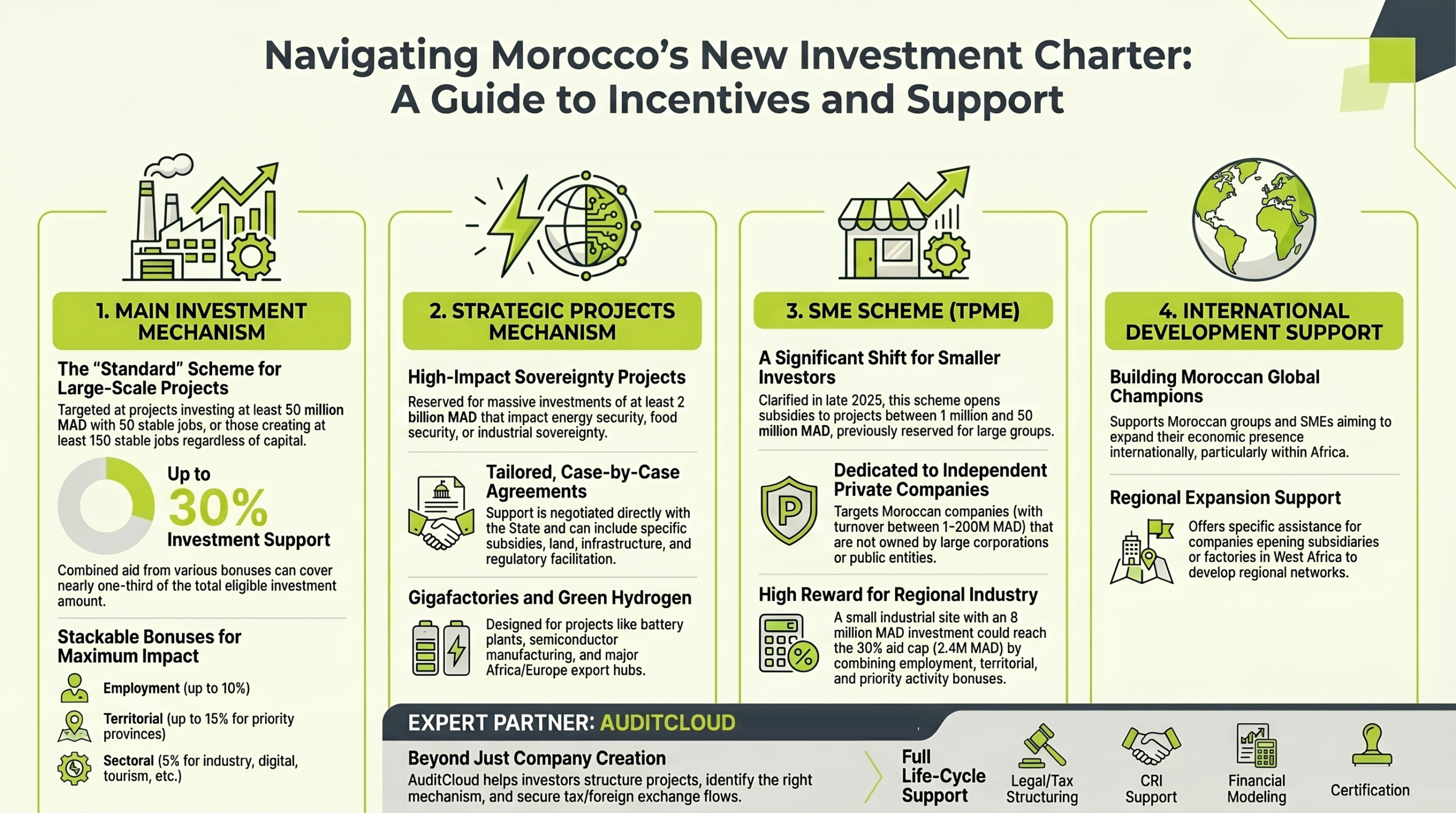
Morocco's new Investment Charter has profoundly changed the country's approach to economic attractiveness.
The objective is no longer solely to offer general tax advantages.
Morocco is now seeking to attract:

  • productive investments,
  • job-creating projects,
  • industrial and technological activities,
  • export projects,
  • and investments capable of developing local ecosystems.

The Charter is based on 4 main support mechanisms, each targeting a different type of investor.

Main investment mechanism: intended for major investment projects.
A mechanism dedicated to strategic projects: concerns major projects having a significant impact on the economy.
SME scheme: Recently clarified by legal texts, it targets small and medium-sized enterprises.
Support mechanism for the international development of Moroccan companies: assists Moroccan companies wishing to invest and develop internationally, particularly in Africa.

1. The main investment mechanism

This is the “standard” mechanism intended for large investment projects.

What is the amount of aid available under this scheme?

The combined aid can reach up to 30 % of the amount of the eligible investment.

Which projects can benefit from this?

  • representing at least 50 million MAD of investment with 50 stable jobs,

OR

  • create at least 150 stable jobs.

How does the system work?

Morocco offers several bonuses that can be combined:

Employment bonus

  • 5 %,
  • 7 %,
  • or 10 %

depending on the job intensity of the project.

Territorial bonus

10 % or 15 % if the project is located in certain priority provinces.

sectoral bonus

5 % for certain strategic sectors:
industry, digital, outsourcing, renewable energies, logistics, tourism, etc.

Other possible bonuses

  • sustainable development,
  • jobs of the future,
  • local integration,
  • female employment.

Example

A European company is opening an industrial plant with:

  • 120 million MAD CAPEX investment,
  • 200 stable jobs,
  • establishment in a region outside Casablanca,

could potentially benefit from several tens of millions of dirhams in aid.

2. The mechanism dedicated to strategic projects

This scheme targets very large projects that have a major impact on the Moroccan economy.

Who is affected?

The projects of at least:

  • 2 billion MAD,

having a significant impact on:

  • employment,
  • energy security,
  • food security,
  • industrial sovereignty,
  • advanced technologies,
  • or Morocco's international influence.

How does the system work?

Unlike the main scheme, here the aid is negotiated “on a case-by-case basis”.
We are moving more towards a logic of strategic agreement with the State.

This may include:

  • specific subsidies,
  • land,
  • infrastructure,
  • administrative support,
  • personalized benefits,
  • regulatory facilitation.

Example

For example, this mechanism could potentially apply to projects such as:

  • gigafactory batteries,
  • green hydrogen project,
  • mega car factory,
  • semiconductors,
  • energy infrastructure,
  • major export project Africa/Europe.

3. The SME scheme

This is probably one of the most significant changes in the new Charter, the details of which were clarified at the end of 2025. Previously, substantial aid was primarily aimed at large corporations. The SME scheme now opens access to subsidies for much smaller projects.

This device can be particularly useful for:

  • foreign industrial SMEs,
  • industrial startups,
  • technology companies,
  • small production units,
  • outsourcing,
  • regional subsidiaries in Africa.

Who is affected?

Private Moroccan companies created by Moroccans or foreigners.

This scheme expressly excludes companies whose shareholders include large companies or public companies:

  • with a turnover between 1 and 200 million MAD,
  • or new companies created less than 3 years ago.

Project conditions

The project must:

  • representing an investment of between 1 and 50 million MAD,
  • have at least 10 % of equity,
  • create enough stable jobs,
  • to be in an eligible activity and region.

Bonuses

The plan includes:

  • an employment bonus:
    • 5 % if the jobs/investment ratio is ≥2 and ≤5,
    • 7 % if the ratio is >5 and ≤10,
    • 10 % if the ratio is >10; ;
  • a territorial bonus:
    • 10 % for certain Category A provinces,
    • 15 % for certain category B provinces; ;
  • a bonus for priority activities:
    • 10 % for certain targeted activities (industry, technology, outsourcing, renewable energies, etc.).

The combined aid can reach up to 30 % of the eligible amount.

Example

For example, a European SME opening:

  • a small industrial site,
  • a software development center,
  • or an assembly unit

with :

  • 8 million MAD investment,
  • 20 jobs,

could potentially benefit from:

  • of an employment bonus of 5 %
    (jobs/investment ratio = 20 ÷ 8 = 2.5),
  • a territorial bonus of 10 % or 15 %
    if the project is located in an eligible province,
  • and a priority activities bonus of 10 %
    if the activity falls within the targeted sectors.

In a favorable scenario, the project could therefore obtain:

5 % + 15 % + 10 % = 30 %

That is, up to:

2.4 million MAD in potential aid
based on an investment of 8 million MAD.

4. The mechanism for the international development of Moroccan companies

This scheme aims to support Moroccan companies that invest internationally, particularly in Africa.

Who is affected?

  • Moroccan groups,
  • Moroccan SMEs,
  • companies wishing to expand outside Morocco.

Objective

Morocco is seeking to:

  • encourage regional expansion,
  • to develop Moroccan champions,
  • strengthen Morocco's economic presence in Africa.

Concrete example

A Moroccan company that:

  • opens a subsidiary in West Africa,
  • invests in a factory,
  • or develops a regional network,

could benefit from specific support.

We can assist you

In practice, the main challenge for a foreign investor is usually not “setting up a company” in Morocco.

The real issue is rather:

  • to structure the project correctly from the outset,
  • identify the right investment mechanism,
  • securing tax and foreign exchange flows,
  • prepare investment agreements,
  • and maximize assistance while remaining compliant throughout the process.

This is precisely where professional support becomes important. At AuditCloud Morocco, we support foreign investors throughout the entire business setup process in Morocco, including:

  • legal and tax structuring,
  • creation of companies and subsidiaries,
  • analysis of eligibility for the Charter's provisions,
  • preparation of investment files,
  • Financial modeling and business plans,
  • CRI support and investment agreements,
  • accounting, tax and social compliance,
  • exchange control regulations,
  • Import/export and customs structuring,
  • accounting, payroll and recurring obligations,
  • as well as certification and attestations related to subsidy schemes when necessary.

The goal is not just to obtain aid, but to build a structure:

  • operationally viable,
  • fiscally secure,
  • compatible with exchange rate rules,
  • and capable of developing sustainably in Morocco and internationally.


As part of the development of its activities, AuditCloud Morocco – Audit and Consulting opens its recruitment campaign audit and accounting interns.

We are looking for motivated students or recent graduates wishing to acquire a concrete professional experience within a dynamic firm, working with a diverse clientele (SMEs, subsidiaries of international groups, associations, public bodies).

Desired profiles

  • Students in accounting, auditing, finance or management

  • Level: Bachelor's +3 to Bachelor's +5

  • Good analytical skills and organizational skills

  • Rigour, curiosity and team spirit

  • Prior experience in a law firm is an asset

Proposed missions

  • Participation in audit and statutory audit missions

  • Assistance with bookkeeping and accounting review

  • Participation in the preparation of tax returns

  • Contribution to consulting and financial analysis work

What we offer

  • Supervision and guidance by experienced professionals

  • Exposure to varied and educational assignments

  • Professional and supportive work environment

  • Opportunities for advancement based on profile and performance

📍 Place Rabat


📩 Candidacy📄Please fill out the following form to submit your application!


Since the January 1, 2025, all companies whose annual turnover excluding taxes is included between 2 and 10 million dirhams are subject to the obligations of Law 69.21 concerning their payment deadlines (deadline for paying their suppliers' invoices).


I. OBLIGATIONS

1. Annual declaration for the 2025 financial year

  • A annual declaration must be filed no later than April 1, 2026.
  • It must include all invoices. paid And unpaid, as well as those that have exceeded the legal deadlines.

2. Quarterly declarations from 2026 onwards

  • Starting with the 2026 financial year, companies in this bracket must file a quarterly statement.
  • The deposit must take place before the end of the month following each quarter.

II. SANCTIONS

1. Late payment of invoices

  • Application of a penalty calculated on the basis of the Bank Al-Maghrib key interest rate,
    plus 0.85% per month or fraction of a month of delay.

2. Failure to file or late filing of returns

  • Fixed fine determined based on annual turnover.

Amount of the sanctions

Annual turnover excluding VATSanction
2,000,000 < CA ≤ 10,000,0005,000 DH
10,000,000 < CA ≤ 50,000,00012,500 DH
50,000,000 < CA ≤ 200,000,00050,000 DH
200,000,000 < CA ≤ 500,000,000125,000 DH
Revenue > 500,000,000250,000 DH

Note

  • For companies with a turnover between 2 and 10 million dirhams, The penalty for late filing or failure to file is 5,000 DH.
  • This fine is in addition to the late payment penalties on invoices exceeding the legal deadlines.


THE Draft Finance Bill (PLF) 2026 It was definitively adopted by Parliament in December 2025, following its successive review by both chambers. Below is an overview of the main tax measures adopted:


1. Common and cross-cutting measures

1.1. Extension of withholding tax (corporate income tax and VAT) on services

The scope of withholding tax is extended to remuneration for services rendered by the following entities:

  • credit institutions and similar organizations,
  • insurance and reinsurance companies,
  • companies whose turnover reaches certain thresholds.

Implementation is gradual, depending on turnover:

  • starting from 1er July 2026: companies with a turnover ≥ 500 million dirhams,
  • starting from 1er January 2027: companies with a turnover ≥ 350 million dirhams,
  • starting from 1er January 2028: companies with turnover ≥ 200 million dirhams.

1.2. Withholding tax on business rents

A withholding tax of 5 % is established on the rental income from built or unbuilt properties and constructions of any kind, when the rents are paid by certain taxpayers to:

  • companies subject to corporate income tax,
  • or natural persons subject to professional income tax (RNR/RNS scheme).

The measure applies from the 1er July 2026. The amount withheld is deductible from the final tax due, with the possibility of a refund in case of excess.

1.3. Extension of the Social Solidarity Contribution (CSS)

The social solidarity contribution on profits and income is extended for the years 2026, 2027 and 2028. It remains payable by companies and natural persons under the actual net profit regime whose annual profit reaches or exceeds 1 million dirhams, according to a progressive scale.

1.4. Modernization of electronic accounting rules

The criteria for maintaining accounting records electronically will be incorporated directly into the law, without reference to a subsequent regulatory text. The objective is to secure the legal framework for the digitization of accounting.

1.5. Harmonization with business difficulty procedures

The tax provisions are aligned with the new procedures provided for by the Commercial Code:

  • prior notification to the administration in the event of a request to open safeguard proceedings,
  • accelerated tax rectification procedure,
  • obligation to provide information in the event of the opening of a receivership or liquidation procedure not initiated by the company.

1.6. Combined tax audit of natural persons

The administration can now proceed, under certain conditions, to a combined control relating simultaneously to:

  • the accounting review,
  • the examination of the individual's overall tax situation.

This control is governed by specific rules regarding duration, notification, and adversarial interviews.

1.7. Updating the rules of limitation in the case of conditional tax benefits

Taxpayers who have benefited from conditional tax advantages and who have provided guarantees may remain subject to the recovery of taxes, duties, fines, penalties and surcharges, even after the expiry of the limitation periods, in the event of non-compliance with the conditions attached to these advantages.

1.8. Simplification of the email address provided to the DGI

Taxpayers will be able to use a freely chosen email address (and no longer necessarily provided by a trusted service provider) for their electronic exchanges with the tax authorities.

1.9. Updating of stamp duties

As a continuation of the dematerialization, the 3 % discount granted to resellers of physical stamps is eliminated, this provision having become obsolete.


2. Corporate Income Tax (CIT)

2.1. Reform of the tax treatment of OPCCs

The tax regime for Undertakings for Collective Investment in Capital (UCITS) has been clarified. Distributions made by these vehicles will be taxed in the hands of the beneficiary according to the real economic nature underlying products:

  • dividends,
  • interests,
  • capital gains from disposal.

This reform aims to guarantee the tax neutrality of OPCCs and to avoid any artificial transformation of the nature of income for investors.

2.2. Revenues related to international shipping vessels

Lease fees and similar remuneration relating to the chartering, leasing or maintenance of vessels used in international maritime transport, when borne or recorded in the name of non-resident persons, benefit from a permanent exemption from withholding tax under the heading of IS.

2.3. Reporting obligation extended to rental income of non-residents

Non-resident companies without an establishment in Morocco, already required to declare capital gains on the sale of securities in Morocco, must now also declare income generated from renting out real estate.

2.4. Deduction of donations made to sports clubs

Companies will be able to deduct from their taxable income donations, in cash or in kind, made to sports clubs established in accordance with Law No. 30-09, up to the following limits:

  • of 20 % of taxable profit, And
  • of a ceiling of 5 million dirhams per financial year.

2.5. Contributions of assets by sports associations: extended exemption

The corporate income tax exemption applicable to asset and liability transfers from sports associations to sports companies has been extended. It now covers transfers made to the real value, and no longer solely at net book value.

In return, in the event of a subsequent sale of the contributed assets, the receiving company will have to include in its taxable income the capital gain calculated on the basis of the initial value of the assets.

2.6. Clarification of the five-year exemption for sports companies

The five-year total exemption from corporate income tax granted to sports companies (Law No. 30-09) is clarified: it applies from the first taxable sale, and not simply from the first year of operation. This clarification helps to secure the starting point of the exemption period.

2.7. Exclusion of the 40 % IS rate for certain microfinance institutions

Public limited companies resulting from the transformation of microcredit associations are no longer subject to the 40 % rate during their first five financial years of operation. They will benefit from the standard corporate income tax rate applicable to companies.


3. Income Tax (IR)

3.1. Payment of income tax on the sale of securities within 30 days

Taxpayers who sell securities, equity or debt instruments not registered with authorized intermediaries will now have to:

  • pay the income tax due for each transfer within 30 days following the transaction, via a notification slip, and
  • file a summary annual statement of all the transfers, which will also serve as the basis for claiming a refund of any excess tax.

3.2. Reclassification of OPCC distributions for IR

Distributions made by UCITS corresponding to capital gains realized by the fund are classified as profits from movable capital. This measure ensures consistency between the treatment of these products under corporate income tax and personal income tax, and offers better tax transparency for individual investors.

3.3. Gradual reduction on the salaries of professional athletes

To support the professionalization of sport, a specific tax allowance will be applied to income paid by sports companies to professional athletes, educators, coaches and technical teams:

  • 90 % for the year 2026,
  • 80 % for the year 2027,
  • 70 % for the year 2028,
  • 60 % for the year 2029.

3.4. Tax advantage for taxpayers in CPU upon cessation of activity

Individuals subject to the Single Professional Contribution (CPU) scheme, not benefiting from any pension scheme and aged at least 65 years old On the date of cessation of their activity, they benefit from:

  • 50% reduction % regarding the capital gain related to the intangible assets of the business,
  • within the limits of 1,000,000 DH.

3.5. Extension of exemptions to CIMR supplementary pensions

The exemptions previously reserved for certain pensions and life annuities are extended to pensions and annuities paid within the framework of group supplementary retirement insurance contracts managed by CIMR, under the same conditions as the basic schemes. This measure strengthens fairness between the different categories of private sector retirees.

3.6. Tax regime for employees of Casablanca Finance City (CFC)

The flat rate of 20 % applicable to the salaries and wages of employees of companies benefiting from CFC status now applies:

  • for a maximum duration of 10 years,
  • on continuous or discontinuous periods of work within the companies concerned.

Employees may, by irrevocable option, choose to be taxed according to the progressive tax scale, provided they notify their employer of their choice before the 1er FEBRUARY of the year in question. CFC companies must attach to their annual declaration of salaries and wages a statement listing the employees benefiting from the scheme.

3.7. Revaluation of the deduction for family expenses

The amounts relating to the deduction for family expenses are updated:

  • Amount per dependent: 600 DH (instead of 500 DH),
  • Overall annual limit: 3,600 DH (instead of 3,000 DH).

4. Value Added Tax (VAT)

4.1. Extension of the exemption for sports companies (2026–2030)

The VAT exemption granted to sports companies is extended for a further period of five years, of the 1er January 2026 to December 31, 2030, in order to allow the new structures to consolidate.

4.2. Harmonization of exemption periods for investment goods

The VAT exemption scheme for investment goods is simplified:

  • Initial duration: 36 months,
  • Possible extension: 24 additional months, whether for local purchases or imports, under certain conditions.

4.3. Framework for formalities for imported capital goods

Import purchases of capital goods under investment agreements are subject to specific regulatory procedures (implementing decree), in order to secure the use of the exemption.

4.4. Extension of the exemption to agricultural inputs

The VAT exemption is extended to all fertilizers and growing media for agricultural use as defined by law no. 53-18. The objective is to align the tax treatment of all agricultural inputs and to reduce the acquisition cost for farmers.

4.5. Reverse charge of VAT on the purchase of waste and metals

Industrial companies subject to VAT must now apply the mechanism of self-assessment on their purchases of new industrial waste, metals, and other recovered materials. They will have to:

  • declare the VAT due on their turnover declaration,
  • and deduct it simultaneously on the same tax return.

4.6. Exemption for short pasta

THE short, uncooked, and unstuffed pasta are added to the list of products exempt from VAT without right to deduction, alongside bread, couscous, semolina, flours intended for human consumption and certain yeasts.

4.7. VAT exemption (with right to deduct) for blood and its derivatives

Blood and its derivatives are exempt from VAT with the right to deduct input tax, including on import, which reduces the cost of these sensitive products while preserving tax neutrality for the operators concerned.


5. Registration fees

5.1. Public procurement: introduction of a 0.1 % duty

Public procurement, initially subject to mandatory and free registration, now supports a registration fee of 0.1 %, due by the successful bidder, in order to improve traceability and access to information for the tax authorities.

5.2. Harmonization of rights regarding guarantees and releases

Secured credit transactions (guarantees, mortgages, pledges) and their releases all benefit from a a single fixed fee of 200 DH, regardless of the nature of the lending institution (credit institution, similar organization or financing company).

5.3. Additional fee of 2 % in case of untraceable payment

An additional registration fee of 2 % is established for transfers of ownership for valuable consideration exceeding 300,000 dirhams:

  • of real estate or real property rights,
  • or business assets,

This right applies only to the portion of the price paid under non-compliant conditions when the payment methods used are untraceable or not mentioned in the transaction.

5.4. Expansion of exempted transactions

Several categories of documents are exempt from registration fees, including:

  • certain real estate acquisitions for social use by social welfare institutions,
  • the transfer of assets within the framework of the restructuring of corporate groups,
  • certain transfers of shares or stock, subject to justification that they are not transparent real estate companies or companies whose assets consist primarily of real estate,
  • Credit agreements granted by credit institutions and similar organizations.

5.5. Tax rate of 5 % on transfers of shares in unlisted real estate companies

Transfers, whether for consideration or free of charge, of shares or units held in unlisted real estate companies and companies whose assets consist primarily of real estate are subject to a rate of 5 %.

5.6. Fixed fee of 1,000 DH for group restructuring operations

Companies that have opted for the group restructuring tax regime benefit from fixed fee of 1,000 DH on asset transfers carried out within this framework.


The information presented in this article is provided for general informational purposes only.
For an analysis tailored to your situation or that of your company, it is recommended to consult us directly in order to obtain specific support that is in line with your context.


plf2026a.png

By Mohamed Yassine Fizazi, Chartered Accountant DPLE – Tax Specialist, Managing Partner AuditCloud Morocco

The 2026 Finance Bill is a continuation of the tax reforms provided for by framework law 69-19, with four main areas:

1. Combating the informal economy and strengthening tax transparency

  • Extension of withholding tax for corporate income tax and VAT to services provided by legal entities to large companies (turnover ≥ 50M), financial institutions and insurance companies.

  • New withholding tax of 5.% on business rents paid to companies subject to corporate income tax and to natural persons engaged in a professional activity.

  • Introduction of an additional registration fee of 2 % on untraceable real estate transactions (cash payment, lack of proof of payment, or payment without the presence of the notary).

  • Mandatory reverse charge VAT on industrial waste and recovered materials, to combat fraud observed in the recycling sector.

  • Strengthening tax controls and audit tools : generalization of the automated risk analysis module, automatic reminders and digital tracking of VAT and income tax refunds
  • Clarification regarding income distributed by collective investment schemes in capital (CIUCs) are now taxed according to the actual nature of the products (interest, dividends or capital gains), in order to avoid any confusion with distributions treated as dividends.

2. Support for the competitiveness and professionalization of key sectors

Agricultural sector

  • The VAT exemption is extended to all fertilizers and growing media for agricultural use.

Sports sector

  • Exemption from corporate income tax for 5 years from the first taxable sales year for sports companies established under Law No. 30-09

  • Deduction of donations paid to these companies (capped at 10 % of net profit, max 5 M DH/year).

  • Degressive tax allowances on income tax for athletes, coaches and technical staff: 90 % (2026), 80 % (2027), 70 % (2028), 60 % (2029)

  • VAT exemption extended for sports activities until December 31, 2030.

Microfinance

  • Institutions resulting from the transformation of microcredit associations into public limited companies will benefit from an exemption from the IS rate of 40 % during their first five fiscal years – welcome support for inclusive banking.

Industrial sector and import/export

  • Selective customs adjustments : Increased import duties on certain finished products (jacquard textiles, household appliances, photovoltaic panels) and reduced duties on industrial inputs (aluminum profiles, PVC resins, aerosol cans) in order to protect domestic production while supporting strategic inputs

  • Government empowerment to modify tariff rates and customs duties during 2026 to respond to economic developments

3. Simplification and harmonization of the tax framework

  • Easing of tax email address management, without the obligation to use an approved service provider.

  • Electronic accounting : elimination of the regulatory reference; the criteria will now be set by the law on the accounting obligations of traders
  • Alignment of VAT exemption periods For capital goods: Additional period extended to 24 months, unified for domestic and import VAT.

  • Standardization of the registration fee at 200 DH for all credit and guarantee transactions.

  • Introduction of a registration fee of 0.1 % on public procurement

  • Safeguard and recovery procedures : obligation for companies in difficulty to inform the tax authorities before the commencement of any proceedings, and generalization of accelerated rectification; electronic filing of the preliminary declaration
  • Stamp duty update : removal of article 236-3° of the CGI relating to the 3 % discount for physical stamps, which became obsolete with dematerialization

4. Social cohesion and continuity of solidarity financing

  • There social solidarity contribution is renewed for the period 2026-2028, at the same progressive rates (1.5% to 5% of 1% of 1% of 3 years) for companies whose profits exceed one million dirhams. This renewal for 2026-2028 is part of the sustainable financing of social protection, direct aid to families, and the social housing program.

5. Digitalization and modernization of tax administration

  • Deployment of the electronic invoicing (large companies in the first phase).

  • Generalization of the electronic notification and of the electronic VAT and income tax refunds.

  • Implementation of modules for’artificial intelligence for automated fraud detection and an "e-control" platform.

  • VAT collection platform for digital services : extension of the automatic collection system for foreign digital service providers


The information presented in this article is provided for general informational purposes only.
They are based on the provisions of the 2026 Finance Bill, published by the Ministry of Economy and Finance, the official presentation note and the analyses available at the time of writing. They do not constitute personalized tax advice or legal counsel.
AuditCloud Morocco and its authors decline all responsibility for decisions made solely on the basis of this information. For an analysis tailored to your situation or that of your company, it is recommended to consult us directly in order to obtain specific support that is in line with your context.


Below is a summary of the main tax measures introduced by the 2025 Finance Law; ;

I. Income Tax (IR)

  1. Reform of the progressive scale :
    • Increase in the exemption from 30,000 to 40,000 dirhams (exemption for salaries under 6,000 dirhams) also applicable to the withholding tax threshold for property income
    • Revision of the scale as detailed below.
    • Applicable from January 1, 2025. 
      Income brackets in dirhams (Before Finance Law 2025) Rates (Before Finance Law 2025) Amounts to be deducted (Before Finance Law 2025) Income brackets in dirhams (After Finance Law 2025) Rates (After Finance Law 2025) Amounts to be deducted (After LF 2025)
      0 to 30,000 0% 0 0 to 40,000 0% 0
      30,001 to 50,000 10% 3000 40,001 to 60,000 10% 4000
      50,001 to 60,000 20% 8000 60,001 to 80,000 20% 10000
      60,001 to 80,000 30% 14000 80,001 to 100,000 30% 18000
      80,001 to 180,000 34% 17200 100,001 to 180,000 34% 22000
      Over 180,000 38% 24400 Over 180,000 37% 27400
  2. Benefits for internships and recruitment :
    • Income tax exemption conditions extended to all trainees (max 6000 dh/month)
    • Exemption for internships limited to 12 months instead of 24 months.
    • Exemption for 24 months if trainees are recruited on permanent contracts (capped at 10,000 dirhams/month).
    • Applicable from January 1, 2025.
  3. New tax categories :
    • Express addition of income categories such as unjustified income discovered during tax audits, winnings from foreign online gambling, and miscellaneous income from lucrative activities not classified in existing tax categories. 
    • Withholding tax of 30% and social solidarity contribution on gambling winnings
    • Applicable from January 1, 2025 & July 1, 2025
  4. Revision of the tax treatment of buybacks of supplementary pensions:
    • Exemption subject to a minimum duration of 8 years for contracts.
    • Clarification of the taxable base for buybacks before this deadline.
    • This requirement is excluded in the event of death or disability.
    • Applicable from January 1, 2025.
  5. Clarification of the tax treatment of property transfers:
    • Taxation of capital gains on land transfers at a value exceeding the acquisition price.
    • Exclusion from income tax for transfers made at their original acquisition price.
    • Applicable from the January 1, 2025.
  6. Eligibility of contributions of shares and equity interests:
    • Confirmation that contributions of shares in unlisted real estate-focused companies are eligible for the tax payment deferral scheme.
    • Applicable according to article 161 bis-II of the CGI.
  7. Taxation of land profits related to expropriation:
    • Clarification of the taxation of land profits realized during expropriations or judicial transfers.
    • Withholding tax is mandatory for these amounts, with the possibility of deducting it from the income tax due.
    • Applicable from July 1, 2025.
  8. Land income :
    • Option for a final tax payment of 20% instead of withholdings of 10% or 15% with obligations to declare global income.
  9. Retirement pensions 
    • Income tax exemption for retirement pensions and life annuities from January 1, 2026 for basic pension schemes.
    • Annual declaration exemption for beneficiaries of these tax-exempt pensions.
    • Transitional reduction of 50% of the IR for pensions and annuities received in 2025.
    • Supplementary schemes remain subject to income tax according to the usual rules.
  10. Other changes:
    • Increase in the income tax reduction for family expenses from 360 to 500 dirhams per dependent (maximum of 3000 dh)
    • The increase in the amount of vouchers representing food or meal expenses issued by employers to their employees to 40 dirhams instead of 30 dh per day worked.

II. Corporate Income Tax (CIT)

  1. Vehicle depreciation :
    • Increase in the deduction limit for passenger transport vehicles 300,000 to 400,000 dirhams, amortizable over 5 years.
    • Applicable from 1 January 2025.
  2. Restructuring of corporate groups :
    • Reduced detention threshold 80% at 2/3 for parent companies.
    • Net capital gains benefit from a payment deferral instead of a postponement.
    • Possibility of transferring fixed assets to net book value in exchange for securities
    • Applicable to transfers made from 1 January 2025.
  3. Joint ventures (SEP) & Economic Interest Groups (EIGs) :
    • Corporate income tax liability is mandatory for SEPs with more than 5 partners or including a legal entity.
    • Integration of GIEs into the field of IS with distribution of results between members.
    • SEPs not subject to corporate income tax must keep accounts.
    • Applicable to financial years beginning on or after January 1, 2026 for SEP.
    • Applicable from 1 January 2025 for GIEs.
  4. Revision of the application procedures for withholding tax on income from shares, equity interests and similar income:
    • Amendment to the provisions of Article 247-XXXVII-C of the French General Tax Code (CGI) to provide for the application of withholding tax to the proceeds from shares, equity interests and similar income distributed, as follows:
      • 12,50%, for amounts distributed from 1 January 2025 onwards; ;
      • 11,25%, for amounts distributed from 1 January 2026 onwards; ;
      • 10%, for amounts distributed from 1 January 2027.
  5. Extension and Expansion of the Capital Gains Tax Allowance on Real Estate 
    • Tax relief of 70% on capital gains from real estate:
    • Extension of the tax relief until December 31, 2030.
    • Extension to land and building sales from 2025.
    • Subject to the reinvestment of proceeds from disposal in accordance with article 247-XXXV of the CGI.
    • Applicable to companies subject to corporation tax.

III. Value Added Tax (VAT)

  1. Removal of VAT application for occasional customers residing in Morocco.
    • Removal of the application of VAT to remote service supplies for occasional customers residing in Morocco.
    • Definition of clear criteria for establishing tax residency in Morocco.
    • Transition to quarterly reporting for non-resident service providers.
  2.  Exemption for capital goods used in private education:
    • Extension of VAT exemption to assets acquired by real estate companies and OPCIs for educational projects.
    • Subject to compliance with regulatory formalities and the obligation to preserve assets.
    • Applicable to companies and OPCIs that have not exceeded the 36-month exemption period before January 1, 2025.
  3. Taxation of dried yeasts subject to VAT:
    • Application of a VAT rate of 20% domestically and on imports to ensure fair competition between local and imported products.
    • Transitional measures for VAT on stocks prior to January 1, 2025 and transmission of a list of debtor customers as of December 31, 2024 for taxpayers concerned by the cash basis system.
  4. Seasoned meats :
    • Extension of VAT exemption to seasoned fresh or frozen meats.
  5. Increase in local resources :
    • Minimum share of VAT allocated to local authorities increased by 30% to 32%.
  6.  Temporary exemption from VAT on the importation of certain products:
    • Application of VAT exemption on the importation of live animals, fresh or frozen meat, cargo rice and virgin and extra virgin quality olive oils.
    • Measure applicable from January 1, 2025 to December 31, 2025, within the limits of the quotas set.

IV. Registration fees

  1.  Clarification of long-term leases:
    • Replacement of the term "emphyteutic lease" with "lease with a duration exceeding 10 years".
    • Revision of the taxable base for leases exceeding 10 years.
    • Total annual rent plus charges (maximum of 20 years)
    • Applicable from January 1, 2025.
  2.  Penalties for electronic recording:
    • Targeted professionals (notaries, adouls, chartered accountants and certified public accountants)
    • A fine of 1000 dirhams for omission or error in electronic registration.
    • Correction possible within 30 days without penalty.
    • Applicable from January 1, 2025.
  3.  Transmission of electronic documents:
    • Notaries are required to transmit documents with electronic signatures. .
    • Applicable from January 1, 2025.
  4.  Control by land registrars:
    • A certificate of registration must be attached to documents presented to the land registrars.
    • Applicable from January 1, 2025.
  5.  Exemption for free transfers to the families of martyrs and wounded soldiers :
    • Exemption from registration fees for gratuitous transfers to their beneficiaries.
    • Applicable from January 1, 2025.
  6.  Tax exemption for the establishment of guarantees:
    • Exemption from registration fees for guarantees and mortgages relating to the payment of taxes.
    • Applicable from January 1, 2025.
  7. Rights for restructuring groups of companies:
    • Setting a registration fee of 1000 dirhams for transfers and contributions related to restructurings.
    • Applicable from January 1, 2025.

V. Special annual tax on vehicles

  1. Extension of payment deadlines :
    • Extension of 30 to 60 days for vehicles put into circulation during the year.

VI. Common Measures

  1. FIFA Representation in Morocco :
    • Tax exemptions (corporate tax, income tax, VAT, registration fees, etc.) for activities related to FIFA and its affiliates.
  2. Extension of tax incentives :
    • Reduction of 70% on capital gains from the sale of fixed assets extended until 2030.
  3. Codification of the tax on cement :
    • Integration into the CGI for simplification and better management.
  4. Amicable agreements :
    • A clarified legal framework for agreements between tax authorities and taxpayers.
  5. Electronic notification :
    • Validation of electronic notifications as equivalent to traditional notifications.
  6. Local Taxation Commissions :
    • Expanding the scope of responsibilities to include new income categories.


Useful links and reference documents:

🔗General Tax Code (CGI) 2025

🔗Summary note published by the DGI, summarizing the main tax provisions of the 2025 finance law.


The guide for Moroccans Residing Abroad (MREs) published by the General Directorate of Taxes (DGI) addresses several key aspects related to tax obligations and benefits available to this category of citizens. It provides information on:

  • Tax assistance services : implementation of regional services and communication tools to answer questions from Moroccans living abroad, including a telephone information center and online assistance.
  • Registration fees : details on reduced rates for the acquisition of real estate and donations, with details on the types of property concerned (housing, land, etc.).
  • Value Added Tax (VAT) : explanation of VAT exemptions for certain categories of goods, as well as the procedure for obtaining the release of mortgage for social housing.
  • The social solidarity contribution : conditions for exemption for buildings used as a main residence and the taxation thresholds for areas exceeding 300 m².
  • Income taxes provisions on property income and profits from the sale of real estate, as well as possible exemptions depending on the case (social housing, donations between relatives).
  • VAT refund : conditions allowing Moroccans residing abroad (MREs) on short stays in Morocco to benefit from VAT refunds on purchases made in Morocco, with strict criteria on the types of goods concerned.

The guide serves as a guidance tool to help Moroccans residing abroad (MREs) understand their tax rights and obligations, while offering them opportunities for exemptions and assistance tailored to their situation.

Tax guide for Moroccans residing abroad (PDF)